Sunday marked a somber milestone in a case that has gripped the nation: one full month since 84-year-old Nancy Guthrie vanished without a trace from her home in the high desert of Arizona.
Despite the deployment of federal resources, the release of new surveillance imagery, and a staggering $1 million reward, the disappearance of the mother of Today show co-anchor Savannah Guthrie remains one of the most confounding active investigations in the Southwest.

A Timeline of Silence
Nancy Guthrie was last seen by her family at approximately 9:30 p.m. on January 31. The alarm was raised the following day, a Sunday, when she failed to appear for her regular church service. By noon, she was officially reported missing, sparking a month-long whirlwind of public appeals, exhaustive searches, and intense media scrutiny.
The investigation took a chilling turn recently with the emergence of a “mysterious man” who claimed to have seen Nancy five days prior to his report. This potential witness has introduced a fresh layer of tension and complexity to a case already defined by conflicting statements and dead-end leads.
The Rugged Terrain of the Catalina Foothills
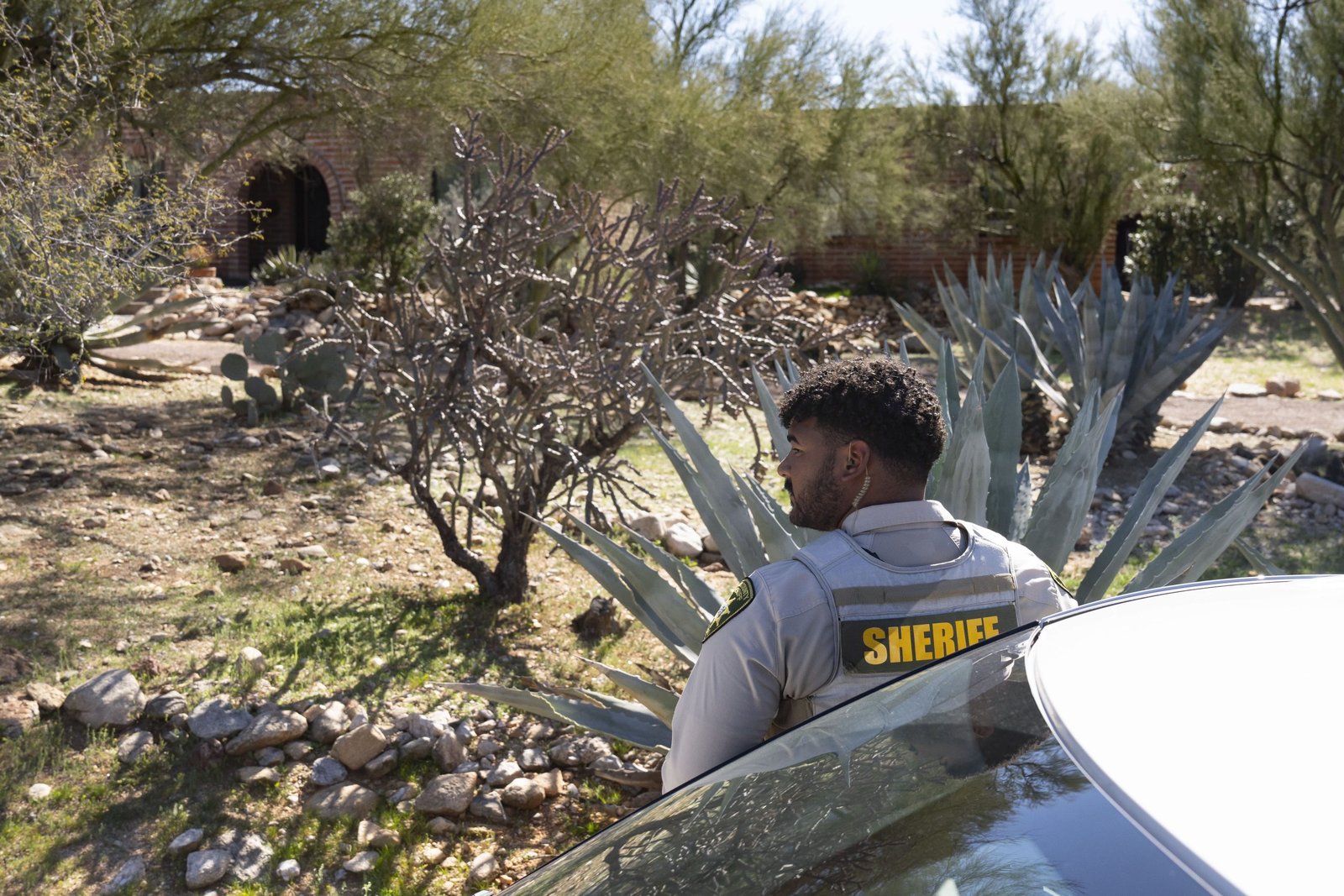
The search efforts are centered on the remote and unforgiving landscape of Tucson’s Catalina Foothills. While the area serves as a peaceful retirement oasis, it is characterized by rocky outcrops, dry culverts, and steep desert slopes—terrain that is notoriously difficult to traverse.
FBI agents and local police have spent weeks combing the brush and rocky inclines surrounding the Guthrie residence. The painstaking nature of the search is dictated by the environment; authorities are meticulously inspecting every accessible corner, wary that the sparse but jagged vegetation could easily obscure a clue—or a person.
Forensic Realities of the High Desert
As the search continues, experts are weighing in on the grim physical realities of the Arizona climate. Speaking on the True Crime with the Sarge podcast, Joe Scott Morgan, a forensic death investigator and host of Body Bags, detailed how the human body reacts to such an environment.
“The lack of humidity doesn’t mean you’re going to have perfect preservation or anything because the skin will desiccate, which is the fancy term for drying out,” Morgan explained. He noted that the state of a body depends entirely on its “entombment”—whether it is sheltered, buried under dirt, or obscured by stones and brush.
Morgan pointed out that in the open desert, the decomposition process differs significantly from more humid regions of the U.S. “The environment itself… the body is not going to appear as it would in other locations,” he said, noting that while the process is brutal, early mummification can sometimes preserve evidence of trauma better than the “soft tissue spoil” seen in wetter climates.
Three Questions Haunting the Investigation
One month in, three major questions continue to haunt the Guthrie family and law enforcement:
What actually happened to Nancy in the hours after 9:30 p.m. on January 31?
Was she the victim of a kidnapping for ransom?
What is the long-term strategy for the search if she is not recovered soon?
Despite the lack of a breakthrough, CNN Chief Law Enforcement Analyst John Miller was quick to push back against the notion that the trail has gone cold.
“This is nowhere near a cold case,” Miller asserted. “They still have leads that are viable that they need to get to, including new leads that came in because of the strategy of holding back the big reward until the time it was needed to re-energize the lead bucket.”
The Guthrie family’s decision to escalate the reward to $1 million is seen by experts as a calculated move to inject fresh momentum into the investigation. As of now, however, the desert remains silent, and Nancy Guthrie remains missing.